Dog food · dry · review from documentation
Blue Buffalo Dog Food Review
Life Protection Formula, the adult chicken and brown rice recipe, read from the label the maker publishes as text rather than as a picture. Every fact below was read live on August 11, 2026.
Updated August 2026 · Label, calories, the maker's recall statement and both state feed registers verified on August 11, 2026
Verdict from the documentation · verified August 11, 2026
The most completely published label of any food we have documented.
Blue Buffalo prints the full guaranteed analysis, the ingredient list in order and the AAFCO statement as readable text: 24% protein and 14% fat minimum, 379 kcal per cup, formulated to meet adult maintenance (bluebuffalo.com, read August 11, 2026). Two documented things to carry into the decision. Peas sit sixth in a recipe sold on brown rice and oatmeal. And the brand appears in the FDA's diet and DCM file with 31 reports, a signal the FDA investigated and never resolved. Full breakdown below · verified August 11, 2026.
Fact line: BLUE Life Protection Formula, adult chicken and brown rice recipe · no price is published on bluebuffalo.com, which links out to retailers (August 11, 2026) · 24.0% protein and 14.0% fat minimum, 3,633 kcal/kg and 379 kcal/cup · guarantor: Blue Buffalo Company Ltd, a General Mills brand · AAFCO statement: formulated to meet, adult maintenance · recall status: the maker states no active recalls as of 8/1/2026 · adult dogs; Blue Buffalo sells separate cat food.
The label, published as text
Credit where it is due, and it is rarer than it should be: Blue Buffalo
publishes its guaranteed analysis, its full ingredient list and its adequacy
statement as machine-readable text on the product page, not as an image of a bag
panel. That single decision is the difference between a label a buyer can check
and one they have to squint at. The adequacy statement, verbatim and in full:
BLUE Life Protection Formula Chicken and Brown Rice Recipe Food for Adult Dogs
is formulated to meet the nutritional levels established by the AAFCO Dog Food
Nutrient Profiles for maintenance.
That is the formulated-to-meet method,
which is nutrient math rather than a feeding trial, and the life stage is adult
maintenance. It is not a puppy food and not an all-life-stages food.
| Nutrient | Declared value |
|---|---|
| Crude protein (min) | 24.0% |
| Crude fat (min) | 14.0% |
| Crude fiber (max) | 5.0% |
| Moisture (max) | 10.0% |
| Calcium (min) / phosphorus (min) | 1.0% / 0.7% |
| Omega-3 / omega-6 fatty acids (min) | 0.5% / 3.0% |
| Glucosamine (min) | 400 mg/kg |
| Calorie content | 3,633 kcal/kg · 379 kcal/cup |
24% protein and 14% fat is a middle-of-the-road adult maintenance spec: above
VeRUS Adult Maintenance at 22% and 10%, below Taste of the Wild High Prairie at
32% and 18%, and effectively level with Nutro Ultra at 24% and 15% (all from
those makers' own published figures, read August 10 and 11, 2026). The calorie
figure carries a footnote worth repeating because portioning depends on it:
*Use a standard 8-oz. measuring cup.
The feeding chart adds the maker's
own caution that Individual dog's requirements may vary due to age, breed,
environment, and activity level
and to ask your veterinarian if you are
unsure
.
The ingredient order, including the peas
The first ten ingredients, in the order the maker publishes them: deboned chicken, chicken meal, brown rice, oatmeal, barley, peas, chicken fat preserved with mixed tocopherols, dried tomato pomace, natural flavor, flaxseed. Fifty-seven ingredients are listed in total, which is a long list by any standard, though most of the tail is vitamins and chelated minerals.
Two observations a buyer can act on. First, this is genuinely a grain-inclusive recipe: brown rice, oatmeal and barley occupy positions three, four and five, so anyone who came here looking for grain-free is in the wrong product line. Second, and less obviously, peas sit sixth. Legumes in the top ten are the ingredient pattern the FDA's diet investigation examined, and their presence in a rice-and-oatmeal food is the sort of thing the front of the bag does not advertise. That is a fact about the recipe rather than a finding about safety, and the FDA record is set out below in the agency's own words. Deboned chicken leading the list is worth reading carefully too: fresh chicken is weighed with its water, so its position ahead of chicken meal reflects pre-cooking weight rather than final protein contribution, which is why the second ingredient matters as much as the first.
LifeSource Bits, and what is claimed for them
The dark kibble pieces mixed through the food are the brand's signature and its most-repeated marketing term, appearing nine times on the product page we read. They are presented as an exclusive blend of antioxidants, vitamins and minerals. Treat that as the company's own positioning: no independent verification of any benefit specific to those pieces is cited on the page, and none is available for us to check. Nothing about them appears in the guaranteed analysis as a separate line, because the guaranteed analysis describes the food as a whole. If a health outcome is what you are buying, that is a conversation with your veterinarian rather than a claim this page can support.
What the maker says about recalls, and its date
Blue Buffalo maintains a recall page and, unusually, self-dates it, which
makes the statement checkable rather than vague: Blue Buffalo doesn't have any
active pet food or treat recalls. For accurate pet food recalls and withdrawal
information, we encourage you to visit the FDA site.
, followed by
As of 8/1/2026
(bluebuffalo.com recall page, read August 11, 2026). Two
things to note about the scope of that sentence. It says no active
recalls, which is a statement about the present rather than about the brand's
history. And it correctly sends readers to the FDA rather than asking them to
take the company's word for it. On our side: no Blue Buffalo entry appeared in
the FDA Recalls and Withdrawals window we scanned in full on August 10, 2026,
whose own stamp that day read "Content current as of: 08/03/2026". That window is
a rolling recent view and not a complete history, and fda.gov does not serve our
server, so it was not re-checked today.
Blue Buffalo in the FDA's DCM file
Anyone researching this brand will meet this, so the page states it with its limits rather than leaving it out. The FDA investigated a potential link between certain diets, many of them legume-rich, and canine dilated cardiomyopathy, and published a graph of the brands named most often in reports it received. That graph exists only as an image on the investigation page and has to be read in a browser; read that way on August 10, 2026, Blue Buffalo appears sixth of the sixteen named brands with 31 reports, counted through April 30, 2019. The FDA's own words, from its June 27, 2019 status report:
To date, the FDA has not established why certain diets may be associated with the development of DCM in some dogs. FDA third status report, June 27, 2019
The investigation page adds that adverse-event numbers do not supply
sufficient data to establish a causal relationship with reported product(s)
,
and its standing status since December 23, 2022 is that FDA does not intend to
release further public updates until there is meaningful new scientific
information to share.
(FDA investigation page).
Read the number for what it is. Report counts track how much of a brand is being
fed as much as anything else, and Blue Buffalo is among the largest sellers in
the category. No causal link was established, no recall was requested, and the
file was never formally closed. If your dog's breed is predisposed to DCM or has
a cardiac history, that is a conversation with your veterinarian before choosing
any diet, and the presence of peas in this recipe is a fact worth taking into
that conversation.
Paper trail · licenses and the regulated label
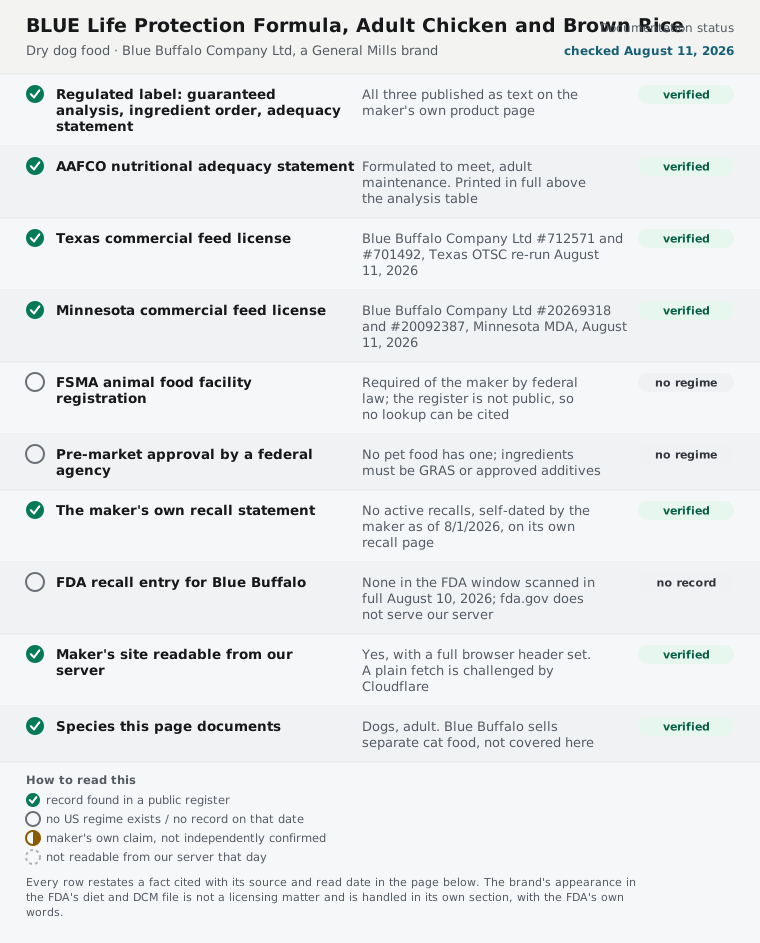
No dog food has pre-market approval from a federal agency:
food for animals doesn't need FDA's pre-market review to be legally
marketed
(FDA).
The per-product regulated document is the label, and states license the firms
that distribute feed. Both public registers returned this guarantor on August 11,
2026, and what they return tells a small story of its own. Blue Buffalo Company
Ltd holds Texas feed licences #712571 and #701492
(Texas OTSC)
and Minnesota commercial feed licences #20269318 and #20092387
(Minnesota MDA).
In each state the company appears twice, once at 11 River Road, Wilton,
Connecticut, its long-standing address, and once at 1 General Mills Blvd,
Minneapolis. The 2018 acquisition by General Mills is visible in the licence
records themselves, which is a more reliable way to establish who stands behind a
food than a marketing page. Federal law separately requires the maker to be a
registered animal food facility under FSMA, and that register is not public, so
no lookup for it can be cited by anyone.
How we verify
FAQ
Is Blue Buffalo grain-free? This recipe is not. Brown rice, oatmeal and barley are the third, fourth and fifth ingredients. The brand sells separate grain-free lines that this page does not cover.
Does it contain peas? Yes, sixth in the ingredient list read August 11, 2026. Worth knowing if you are avoiding legumes because of the FDA's diet investigation, which is set out above.
What life stage is it for? Adult maintenance, stated verbatim in the adequacy statement on the product page. It is not formulated for growth, so it is not a puppy food.
Has Blue Buffalo been recalled? The maker states it has no active recalls, self-dated 8/1/2026, and points readers to the FDA. No Blue Buffalo entry appeared in the FDA window we scanned on August 10, 2026, which is a rolling recent view rather than a full history.
Who owns Blue Buffalo? General Mills. You can see it in the state feed registers, where Blue Buffalo Company Ltd is licensed both at its Wilton, Connecticut address and at 1 General Mills Blvd, Minneapolis.
What does it cost? The maker publishes no price and links out to retailers instead, and we do not quote retailer prices we have not read ourselves.
Checked August 11, 2026: product page, guaranteed analysis, ingredient list, calorie content, feeding chart, the maker's recall page and both state feed registers all read live that day; page created at the site standard. The FDA recall window and DCM graph keep their August 10, 2026 read dates.
Sources · all read live on August 11, 2026 unless dated otherwise
- Blue Buffalo · Life Protection Formula, adult chicken and brown rice (guaranteed analysis, AAFCO statement, ingredients, calories, feeding chart)
- Blue Buffalo · recall page (self-dated statement)
- Texas OTSC · Active Feed Licensee · Minnesota MDA · license lookup
- FDA · Recalls and Withdrawals · window scanned in full August 10, 2026
- FDA · third DCM status report, June 27, 2019 · FDA · DCM investigation page and brand graph
- FDA · regulation of pet food (no pre-market review)
Label values and licences move; every one above carries its read date and will be re-read at the next edit of this page. Compare it with the other brands in the dog food hub.