Dog food · dry · review from documentation
VeRUS Dog Food Review: Adult Maintenance
A small Maryland brand that publishes more nutrient detail than most large ones, and does not publish the one label sentence that decides who the food is for. Every fact below was read live on August 11, 2026.
Updated August 2026 · Label, nutrient PDF, prices on the maker's own store and both state feed registers verified on August 11, 2026
Verdict from the documentation · verified August 11, 2026
Unusually transparent on nutrients and unusually quiet on paperwork.
VeRUS publishes both guaranteed and as-fed values plus a full nutrient PDF, and its Adult Maintenance formula runs 22% protein minimum and 361 kcal/cup at $115.49 for 35 lb on its own store (read August 11, 2026). Three documented reasons for care: no AAFCO adequacy statement appears anywhere we read, its two published nutrient documents disagree with each other, and at $2.15 to $2.28 per 1,000 calories it is the priciest food we have costed. Full breakdown below · verified August 11, 2026.
Fact line: VeRUS Canine Adult Maintenance Formula, the lamb meal, oats and brown rice recipe · $24.99 for 4 lb to $115.49 for 35 lb on veruspetfoods.com, the maker's own store (August 11, 2026) · 22% protein minimum, 10% fat minimum, 361 kcal per cup · guarantor: VeRUS Pet Foods · AAFCO adequacy statement: not published anywhere we read · recall status: no VeRUS entry in the FDA recall window scanned August 10, 2026 · dog formula; VeRUS sells separate cat food.
The one document that is not there
Start with what is unusual in a good way. VeRUS publishes, on the product
page itself, a guaranteed analysis and an as-fed column beside it, plus a
downloadable nutrient profile giving thirteen amino acids, seven minerals and
fourteen vitamins by weight. Very few brands at any price publish that much.
Now the gap. The nutritional adequacy statement is the sentence on a bag that
names how the recipe was substantiated, by nutrient formulation or by feeding
trial, and for which life stage. It is the single most decision-relevant line on
any pet food label. We looked for it on the product page, in the downloadable
nutrient profile, on the manufacturing page and through the FAQ, all read
August 11, 2026, and it is not there. The nearest thing published is a
marketing sentence in the FAQ, Our foods are formulated to exceed standards
of nutrition than those established by AAFCO
(their wording), which names
neither a method nor a life stage, and a product-page line promising
complete and balanced nutrition for the life of your dog
. That phrasing
implies an all-life-stages profile without stating one. The statement is
presumably printed on the bag, as the law requires. It is simply not something a
buyer can check before ordering, which is exactly when it matters.
Guaranteed against as-fed, in one table
| Nutrient | Guaranteed analysis | As fed |
|---|---|---|
| Crude protein (min) | 22.00% | 24.33% |
| Crude fat (min) | 10.00% | 11.90% |
| Crude fiber (max) | 4.50% | 2.98% |
| Moisture (max) | 10.00% | 6.66% |
| Omega-3 / omega-6 (min) | 0.36% / 1.39% | 0.60% / 2.44% |
| L-carnitine (min) | 35 mg/kg | 60.80 mg/kg |
| Calories | 3,184.37 kcal ME/kg · 361 kcal ME/cup | |
Read the two columns together and you learn something a guaranteed analysis alone hides: the real protein sits about two points above the printed minimum, and the real fiber is well under the printed maximum. The ingredient list opens lamb meal, ground oat groats, ground brown rice, rice bran, ground grain sorghum, menhaden fish meal, chicken fat preserved with mixed tocopherols. Two things follow from that order. This is a grain-inclusive food, not a legume-heavy one. And despite the lamb branding, it contains both fish meal and chicken fat, which matters if you are feeding a dog with a chicken or fish sensitivity. At 22% protein minimum this is also a moderate-protein food, well below the 32% of Taste of the Wild High Prairie: neither figure is better in the abstract, but a working or very active dog is the wrong buyer here.
Where the two nutrient documents disagree
VeRUS publishes its typical values twice: in the as-fed column on the product
page, and in a downloadable nutrient profile linked from the same page. Read on
August 11, 2026, the two do not match. The product page gives 3,184.37 kcal
ME/kg and 361 kcal per cup; the PDF gives 3,383.78 kcal ME/kg for the same
formula, about 6% more energy. The protein, fat, moisture, ash and carbohydrate
figures differ too: 24.33% against 23.16% protein, 11.90% against 10.88% fat,
6.66% against 7.00% moisture, 8.95% against 9.10% ash, and 44.18% against 47.10%
carbohydrate. Neither document is dated, so there is no way to tell from outside
which is current, and the PDF's own footnote allows for drift:
These are target nutritional guidelines and slight variations may occur
.
A 6% energy difference is not a rounding artifact, and energy is the number a
careful owner uses to set portions and compare cost. The guaranteed analysis,
which is the legally binding part, is the same in both places: 22% protein
minimum and 10% fat minimum. If you are counting calories for a dog on a weight
plan, ask the company which figure is current before relying on either.
What it actually costs to feed
| Bag | Price | Price per pound |
|---|---|---|
| 4 lb | $24.99 | $6.25 |
| 12 lb | $49.99 | $4.17 |
| 25 lb | $89.24 | $3.57 |
| 35 lb | $115.49 | $3.30 |
Price per pound is the wrong comparison for dog food, because a denser food feeds smaller portions. The honest number is cost per calorie, and it can be worked out here because VeRUS publishes its energy density, though as the section above shows it publishes two different figures. Using the product page's 3,184.37 kcal per kilogram, the 35 lb bag at $3.30 per pound costs about $2.28 per 1,000 calories; using the PDF's 3,383.78, about $2.15 (our arithmetic, from the maker's own published price and calorie figures on August 11, 2026). Against the only same-day, same-kind comparison we hold, Zignature Inception Chicken Meal on its own store, that food works out at about $1.41 per 1,000 calories. VeRUS is therefore roughly 50 to 60% more expensive to feed, calorie for calorie, than that alternative. Taste of the Wild High Prairie was $2.11 per pound at Chewy on August 10, 2026, but that is a different retailer on a different day and is not a like-for-like comparison. None of this makes VeRUS bad value if you want what it sells. It does mean the premium is real and worth naming.
The health claims on the product page
The Adult Maintenance page lists benefits that go beyond nutrition, in the
maker's words: the formula is Hypoallergenic
, it
Reduces itchy, watery eyes and tear stains
, and
Yucca schidigera is used for anti-inflammatory and joint health aid
(read August 11, 2026). These are the brand's claims and this page neither
adopts nor tests them. Two notes for a buyer. "Hypoallergenic" is not a
regulated term in pet food, and the maker's own reasoning for it, that lamb is a
less common protein, does not extend to the fish meal and chicken fat that are
also in the recipe. And any claim about eyes, inflammation or joints is a
question for your veterinarian about your individual dog, not something a bag of
kibble can promise. If a food is being chosen to manage a diagnosed condition,
that is a conversation with a vet, and often a therapeutic diet rather than a
retail one.
Who makes it, and what they say they test
VeRUS states it is a veteran and family-owned and operated business since
1993
and that Our dry food is manufactured in upstate New York and Ohio,
while our canine and feline canned formulas are made in South Dakota.
(VeRUS FAQ, read
August 11, 2026). Its quality claims are specific enough to be worth quoting:
Our food is tested every 15 minutes during the production process.
and
quarterly third-party testing, with the
manufacturing page
adding that every batch is held as Test & Hold
and retested before
release. All of that is the company describing its own process; none of it is
independently audited in any public record we can cite. On recalls the brand
states: VēRUS Pet Foods has never been involved in any recall since its
inception 30 years ago, in 1993.
That is consistent with the FDA recall
window we scanned in full on August 10, 2026, which lists no VeRUS entry, though
that window is a rolling recent view rather than a full history.
Grain-inclusive, and the FDA diet file
This recipe is built on oats, brown rice and sorghum, with no peas, lentils
or potatoes in the ingredient list read August 11, 2026. That places it outside
the diet pattern the FDA examined when it looked at a possible link between
certain diets and canine dilated cardiomyopathy, and the FDA's own conclusion on
that investigation remains: To date, the FDA has not established why certain
diets may be associated with the development of DCM in some dogs.
(FDA third status report, June 27, 2019).
The investigation has not been updated since December 23, 2022
(FDA investigation page).
Nothing was proved and nothing was cleared, so an ingredient list is context,
not protection. For a dog with a cardiac history, ask your veterinarian.
Paper trail · registers and the regulated label
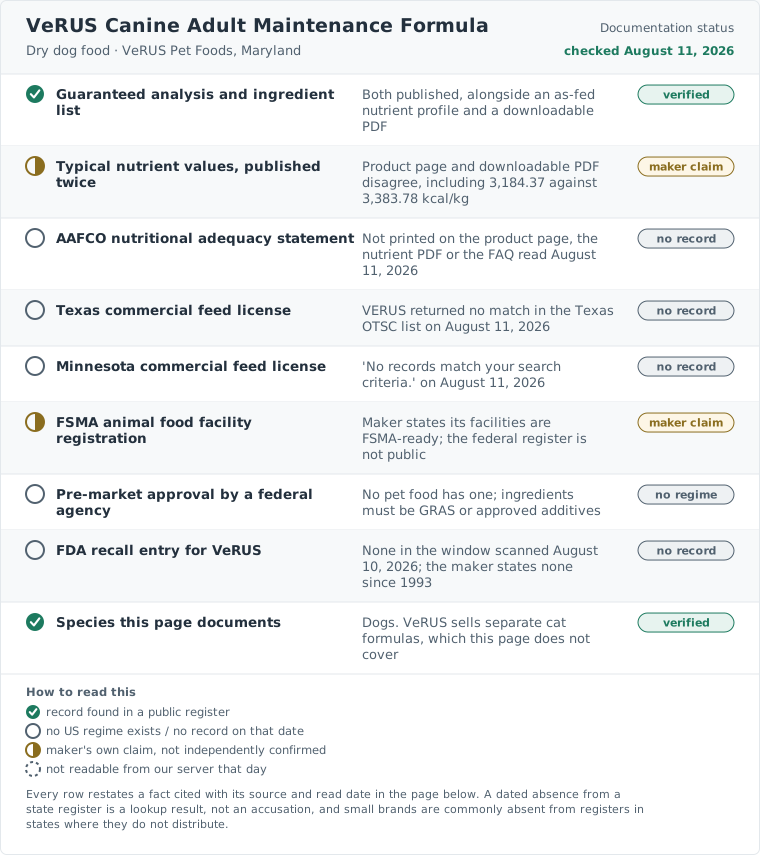
No dog food has pre-market approval from a federal agency:
food for animals doesn't need FDA's pre-market review to be legally
marketed
(FDA),
so the per-product regulated document is the label, and states license the firms
that distribute feed. We ran both public registers we can query on August 11,
2026. VERUS returned no match in the
Texas OTSC Active Feed Licensee
list, and the
Minnesota MDA
search returned No records match your search criteria.
Those are dated
absences from two states, not findings of wrongdoing: a firm needs a license
where it distributes, and a small brand may simply not distribute in Texas or
Minnesota. For contrast, the same two lookups on the same day returned records
for Diamond Pet Foods, Pets Global and Mars Petcare US, the guarantors behind
the other foods in our
dog food hub. On federal registration,
the maker states its plants are FSMA-ready (Food Safety Modernization
Act)
. Being FSMA-ready is the company's phrase, not a register entry: the
law requires the maker to be a registered animal food facility, and that
register is not public, so nobody can cite a lookup for it, here or anywhere
else.
How we verify
FAQ
Is VeRUS AAFCO approved? No food is: AAFCO approves nothing. The meaningful line is the adequacy statement, and VeRUS does not publish one on the product page, the nutrient PDF or the FAQ as read on August 11, 2026. Check the printed bag panel, or ask the company, before buying for a puppy or a pregnant dog.
Why is it absent from the state license registers? Because a feed license is required where a firm distributes, and the two registers with public lookups are Texas and Minnesota. An absence on August 11, 2026 means no record in those two states on that date and nothing more.
Is it good for allergies? The maker calls it hypoallergenic because lamb is a less common protein, but the recipe also contains menhaden fish meal and chicken fat. For a dog with a diagnosed food allergy, ask your veterinarian: elimination diets are a clinical process, not a shelf choice.
How does the price compare? Between $2.15 and $2.28 per 1,000 calories for the 35 lb bag, depending on which of the maker's two published energy figures you use, against about $1.41 for Zignature Inception Chicken Meal on its own store the same day. All three numbers are our arithmetic from prices and calories read August 11, 2026.
Do they make cat food too? Yes, VeRUS sells separate canine and feline formulas. This page documents the canine Adult Maintenance formula only, and none of these figures should be applied to a cat.
Checked August 11, 2026: product page, nutrient profile PDF, FAQ, manufacturing page and both state registers read live that day; page created at the site standard.
Sources · all read live on August 11, 2026 unless dated otherwise
- VeRUS · Canine Adult Maintenance Formula (guaranteed and as-fed analysis, calories, ingredients, prices, claims)
- VeRUS · FAQ (ownership, plants, testing cadence, recall statement, AAFCO wording)
- VeRUS · manufacturing (FSMA-ready claim, Test and Hold process)
- Texas OTSC · Active Feed Licensee · Minnesota MDA · license lookup
- FDA · Recalls and Withdrawals (window scanned August 10, 2026)
- FDA · third DCM status report, June 27, 2019 · FDA · DCM investigation page
- FDA · regulation of pet food (no pre-market review)
Prices and label values move; every one above carries its read date and will be re-read at the next edit of this page. Compare it with the other brands in the dog food hub.